Introduction
The digital marketing landscape is rapidly changing, with 2025 poised to be a transformative year for businesses globally. Staying ahead of these digital marketing trends isn’t just beneficial—it’s essential for survival in today’s competitive market. Moreover, let’s explore the game-changing trends that are redefining how brands connect with their audiences.

AI-Powered Personalization Takes Center Stage
Artificial intelligence has moved beyond buzzword status to become the backbone of modern marketing strategies. Consequently, in 2025, AI-driven personalization is delivering hyper-targeted content that resonates with individual users at unprecedented levels. Additionally, from predictive analytics to automated customer journeys, businesses are leveraging machine learning to understand consumer behavior and deliver experiences that feel tailor-made.
Furthermore, smart marketers are using AI tools to analyze vast amounts of data, predict customer needs, and create dynamic content that adapts in real time. This isn’t just about sending personalized emails anymore. Instead, it’s about creating entire ecosystems that respond intelligently to every interaction.
Voice Search Optimization Becomes Non-Negotiable
With smart speakers in millions of homes and voice assistants on every smartphone, voice search optimization has become critical. In fact, by 2025, voice commands will conduct nearly 50% of all searches, radically altering how businesses approach their SEO services strategy.
What is the key difference? Voice searches are conversational and question-based. Therefore, marketers must optimize for long-tail keywords and natural language patterns. Content needs to answer specific questions clearly and concisely, positioning brands as the go-to source for voice assistant responses.
Short-Form Video Content Dominates
The reign of short-form video content continues to intensify. Notably, platforms like TikTok, Instagram Reels, and YouTube Shorts have revolutionized content consumption, with users demanding bite-sized, engaging videos that deliver value within seconds.
As a result, successful brands in 2025 are creating authentic, behind-the-scenes content that builds genuine connections. The focus has shifted from polished production to relatable storytelling that resonates emotionally with viewers.
Privacy-First Marketing Strategies
With increasing data privacy regulations and growing consumer awareness, privacy-first marketing has evolved from optional to mandatory. Third-party cookies are virtually extinct, forcing marketers to pivot toward first-party data collection strategies.
Brands are building trust by being transparent about data usage and providing genuine value in exchange for customer information. Zero-party data—information that customers intentionally share—is now the goldmine that smart marketers are cultivating through interactive experiences and preference centers.
Social Commerce Integration
The line between social media and e-commerce has completely blurred. In 2025, social platforms are full-fledged shopping destinations where discovery, consideration, and purchase happen seamlessly within a single app.
Instagram, Facebook, TikTok, and Pinterest have evolved into sophisticated marketplaces with advanced features like live shopping events, AR try-ons, and one-click checkout. Brands that integrate social commerce into their strategy are capturing impulse buyers at the exact moment of inspiration.
Conclusion
The digital marketing trends of 2025 reflect one clear truth: success belongs to brands that prioritize authentic connections, embrace emerging technologies, and respect consumer privacy. Whether you’re leveraging AI for personalization, optimizing for voice search, or exploring social commerce, the key is to remain adaptable and customer-centric.
The future of digital marketing isn’t about following every trend—it’s about identifying which innovations align with your brand values and audience needs. As we navigate this exciting landscape, remember that the most powerful marketing strategy combines cutting-edge technology with timeless principles of trust, value, and genuine human connection.
Ready to transform your digital marketing strategy for 2025? Our team of experts specializes in implementing cutting-edge marketing solutions tailored to your business goals. From AI-powered campaigns to voice search optimization, we help brands stay ahead of the curve. Explore our comprehensive digital marketing services and discover how we can elevate your online presence today!
Frequently Asked Questions (FAQs)
What are the top digital marketing trends in 2025?
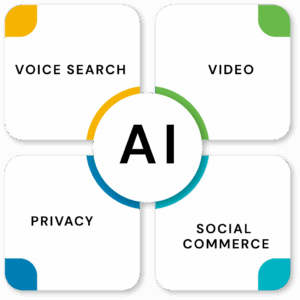
The top digital marketing trends in 2025 include AI-powered personalization, voice search optimization, short-form video content, privacy-first marketing strategies, and social commerce integration. These trends are reshaping how businesses connect with their audiences.
How is AI changing digital marketing in 2025?
AI is transforming digital marketing by enabling hyper-personalized customer experiences, predictive analytics, automated content creation, and intelligent customer journey mapping. Businesses use AI to analyze data and deliver real-time, tailored content to individual users.
Why is voice search optimization important for businesses?
Voice search optimization is crucial because nearly 50% of all searches in 2025 are conducted through voice commands. Consequently, businesses must optimize for conversational, long-tail keywords and natural language to appear in voice assistant results.
What type of video content works best in 2025?
Short-form video content works best in 2025, particularly on platforms like TikTok, Instagram Reels, and YouTube Shorts. Authentic, behind-the-scenes content that tells relatable stories performs better than highly polished production videos.
How can businesses adapt to privacy-first marketing?
Businesses can adapt to privacy-first marketing by collecting first-party and zero-party data, being transparent about data usage, and providing genuine value in exchange for customer information. Building trust through ethical data practices is essential.
What is social commerce, and why does it matter?
Social commerce refers to buying and selling products directly within social media platforms. It matters because it allows customers to discover, consider, and purchase products seamlessly without leaving their favorite apps, increasing conversion rates significantly.